

By Grant Saum, Mid-South Regional Communications Manager, The Cotton Board

Across the Mid-South, Cotton Incorporated continues to invest in the future of cotton through its Agricultural and Environmental Research Division, funding projects that directly impact grower profitability and sustainability.
Through two primary funding avenues — Core and State Support Programs — Cotton Incorporated partners with universities, scientists and growers to tackle production challenges unique to cotton producersacross Arkansas, Louisiana, Mississippi, Missouri and Tennessee.
The Core Program addresses research priorities that are regional or Beltwide in importance. Managed by Cotton Incorporated’s project managers, Core-funded projects focus on key areas such as agronomy, breeding and genetics, engineering, weed management, pathology and entomology. The State Support Program, by contrast, is locally driven. Each state’s grower-led committee identifies and funds research projects specific to its needs using 7.5 percent of grower contributions from the Research and Promotion Program.
In 2025, the Cotton Research and Promotion Program supported 119 Cotton Incorporated research projects across the Mid-South, representing an investment of approximately $2.3 million. Of that total, 69 projects ($1.32 million) were funded through the Core Program and 50 projects ($989,000) through the State Support Program.
“Investing in research is investing in the future of cotton,” said Dr. Ryan Kurtz, Vice President of Agricultural and Environmental Research at Cotton Incorporated. “Through our partnerships with land-grant universities and local scientists, we’re turning innovation into practical tools that growers can use every day.”
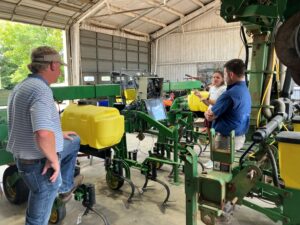
One project receiving significant attention is the “See and Till” initiative at Mississippi State University’s Mississippi Agricultural and Forestry Experiment Station. Led by Drs. Wes Lowe, Daniel Chesser, and Brian Pieralisi, this Cotton Incorporated-funded effort uses artificial intelligence and automated mechanical technology to combat herbicide-resistant weeds. Unlike traditional broadcast spraying, the See and Till tool identifies individual weeds in real time and determines the difference between a cotton plant and a weed species. Once the recognition is made, it lowers a tine to plow the weed with minimal disturbance to the soil. If needed, a pre-emergent is then applied to combat the potential of regrowth of weeds.
What makes the system stand out is its “build-it-yourself” design. Rather than requiring producers to purchase new equipment, researchers are finding ways to retrofit existing cultivators with AI-driven cameras and hydraulic tillage tines. The result is a practical, affordable solution that allows farmers to target weeds more precisely while conserving soil health and reducing chemical use.
Another Mid-South project, supported through the State Support Program, is evaluating the economic value of ThryvOn cotton traits and insecticides in Louisiana. Led by Dr. Dawson Kerns at the LSU AgCenter’s Macon Ridge Research Station, this multi-year study examines how ThryvOn cotton can help producers reduce insecticide use while maintaining yield and fiber quality.
The research compares ThryvOn and non-ThryvOn cotton under standard pest management programs, focusing on thrips and tarnished plant bugs—two of the most costly pests in Louisiana cotton. Preliminary results show that ThryvOn plots required fewer foliar applications and achieved comparable or better yields, resulting in a measurable reduction in input costs. By determining the cost-effectiveness of new insecticide strategies and varietal traits, this work provides growers with real-world data to guide pest management decisions.
In a time when every input dollar matters, Cotton Incorporated’s commitment to Mid-South producers, and producers across the Cotton Belt, remains steady. These projects focus on practical solutions that help growers cut costs and protect yields in a challenging marketplace. Through the Cotton Research and Promotion Program, producers’ investments are focused on keeping cotton competitive, resilient, and ready for the future.
By Grant Saum, Mid-South Regional Communications Manager, The Cotton Board
Article addendum to be printed: Funded by America’s cotton producers and importers through check-off dollars collected by The Cotton Board, the Cotton Research and Promotion Program’s research and promotion activities are conducted by its contractor Cotton Incorporated, with the purpose to increase the demand for and improve the market position of cotton.