

Dr. John Robinson in the Department of Agricultural Economics at Texas A&M University.
It is never too early to develop a marketing plan for the upcoming crop.
Longer run price outcomes for the 2026 crop depend on expectations of supply and demand. The first supply-related question is how much acreage will be planted. The price of competing crops, relative to cotton prices, is an important consideration to the level of planted acreage. The chart below shows a fairly strong relationship between the level of U.S. upland and pima cotton planted (as measured on June 30) and the ratio of December CBOT corn futures and ICE cotton futures during the first quarter of the year. The higher the ratio, the less cotton is planted, all other things equal. Of course, there are other important competing crops as well: sorghum, soybeans, peanuts, and perhaps wheat. And there are other non-price influences, including how dry it is in Texas, the insurance base price, fixed cost influences, and the psychological influence of the preceding growing season. But the price ratio of corn to cotton appears to capture a lot of these other influences in explaining variations in cotton plantings.
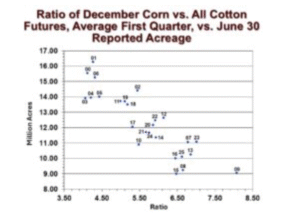
What does the above chart imply for 2026? As of late October, the Dec’26 CBOT corn/Dec’26 ICE cotton price ratio is historically associated with between 10.0 and 10.5 million acres of all cotton. Obviously, the analysis above depends on price ratios which may change between now and early 2026. Furthermore, the price ratio approach to forecasting planted acreage will be replaced by grower survey results like the NCC’s (9 million, circa February 9) and USDA’s Prospective Plantings report (March 31) and Acreage report (June 30), and later USDA FSA certified acres data.Whatever is planted will likely happen under relatively dry conditions, as indicated by the current drought monitor. This suggests an above average level of early season abandonment, as assumed by USDA at their February Outlook Forum. But the story is more complicated than that. NOAA’s Climate Prediction Center predicts “A transition from La Niña to ENSO-neutral is expected next month [i.e., April], with ENSO-neutral favored through May-July 2026 (55% chance). In June-August, El Niño is likely to emerge (62% chance) and persist through at the least the end of 2026.” Thus there is potential for beneficial rains on whatever crop is still standing in mid to late summer. That situation may create late season uncertainty about resulting yield per harvested acre.
Dr. John Robinson in the Department of Agricultural Economics at Texas A&M University.
Link:https://cottonmarketing.tamu.edu/newcrop-fundamentals-outlook-and-caveats/