
AMANDA SCHERER
BIRMINGHAM, ALABAMA
Until recently, it has been pretty dry across Alabama, which has kept our risk for seedling disease low. However, as cotton planting continues to increase across the state, wet, cool weather could increase the risk of seedling disease in some areas. Cotton seedling diseases can cause issues before (pre-emergence damping-off) and/or after (post-emergence damping-off) emergence. Several pathogens, including Rhizoctonia solani, Pythium spp., Fusarium spp., and Thielaviopsis basicola, have been associated with seedling diseases in Alabama cotton. These pathogens can occur alone or together and cause severe stand losses. Severe stand losses may lead to replanting, increased input costs, delayed crop development, and reduced yields.
Over the past 30 years, the National Cotton Council’s National Cottonseed Treatment Program has conducted coordinated seed treatment trials across 10 U.S. states, generating data from more than 500 field trials. Using a curated subset of 409 trials, a team of researchers led by Dr. Zach Noel at Auburn University developed a predictive model that estimates cotton seedling emergence by integrating environmental conditions and pathogen risk.
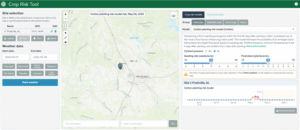
This model, now available through the Cotton Planting Risk Tool on the Crop Protection Network (CPN), provides a data-driven way to assess planting risk and evaluate seed treatment benefits. To use the tool, select the cotton planting risk model, choose a field location, and define the time window for weather data. Users can adjust inputs such as seeding rate, target final stand, and whether Pythium pressure is expected. The model’s output provides the probability of failing to reach the desired stand, helping inform planting timing, replant decisions, and seed treatment strategies (Figure 1).
To help reduce your risk for seedling diseases:
-
Select seed with high germination rates.
-
Improve soil drainage.
-
Rotate to a non-host crop in fields that have had seedling disease issues in the past.
-
Sanitize and rinse equipment after use to remove soil and spores and prevent the spread of soilborne fungi.
-
Only plant treated seed. All cotton seed offered for sale in Alabama is treated with fungicides and insecticides, which are often sufficient for disease management unless seed quality is low or weather conditions are unfavorable for germination.
-
If risk is high, consider using an in-furrow fungicide for additional protection. See the ACES Cotton IPM Guide for more information on fungicides and rates.