Scout For Foliage Feeding From Asiatic Garden Beetle
GUY COLLINS, DR. ADRIAN PEKARCIK AND DR. DOMINIC RESIG
RALEIGH, NORTH CAROLINA
Asiatic garden beetle is an invasive insect that can occasionally injure seedling cotton in North Carolina. Adult emergence began in mid-May this year, and we expect activity to increase as we move into June. Some consultants are already finding fields with enough feeding injury to justify treatment.
This pest has become more noticeable in recent years. In 2023, growers reported scattered but widespread feeding injury across parts of the region. We discussed Asiatic garden beetle at county winter meetings in 2024, and it showed up again in some fields in 2025. The main concern is seedling cotton. If cotton is growing quickly, plants can often tolerate some feeding and recover. If growth is slow, injury can become more important.
This insect spends most its life as a grub below the soil surface. During the spring, it emerges as an adult to mate and lay eggs for the next generation. By day, adults hide below the soil surface and go unnoticed. The adults are active at night, and will emerge to feed on the nearest available foliage, including cotton and many other plants. Here are clues for what to look for.
This insect is most prevalent in sandy soils. We have seen most issues from this insect in sandy-well drained soils, often where peanuts are grown, in areas as far south as Pitt County up north into Virginia. Scouts will first notice foliage feeding.
On cotton that has some size, foliage feeding is a non-issue. However, on seedling cotton, feeding can delay development and, in cases where the terminal is destroyed, can lead to plant death and severe stand loss.
Adult Asiatic garden beetles seem to be particularly sensitive to in-furrow insecticides, such as AgLogic. Often scouts will notice dead adult beetles that fed on cotton plants in fields treated with these insecticides. The beetles must feed on foliage to become intoxicated. However, even though there may be numerous dead beetles, feeding can still be significant. We are collaborating on a 2026 at-planting trial for this insect, but don’t have results yet.
A final clue is the presence of emergence tunnels from the adults. If scouts find these tunnels, they can often scratch just below the soil surface and find adults that have not yet emerged.
Unfortunately, Asiatic garden beetle emergence takes place over an extended time period and this is what makes treatment options complicated. Dr. Sean Malone (VA Tech) has been trapping Asiatic garden beetles in southeast Virginia during 2024. Note the distinct peaks in emergence and the long time periods of emergence. We likely will not reach peak emergence for 2026 until June.
Growers with Asiatic garden beetle injury on seedling cotton understandably want to treat with a foliar insecticide. Foliar control can help when sprays contact adult beetles feeding on the plant, and our 2024 replicated trial showed that insecticides can kill adults. However, control can be inconsistent because many beetles remain below the soil surface, where foliar sprays cannot reach them. Although adults are most active at night, our trial found no difference between daytime and nighttime applications. One likely reason is that adults emerge over an extended period. A spray may kill exposed beetles present at the time of application, but it will not affect beetles still in the soil that emerge later. As a result, growers should not expect one insecticide application to eliminate the problem, especially if the field has not reached peak emergence.
Replanting of severely affected may be appropriate, but must be done so quickly. Replanting beyond the first week of June increases risks associated with late planting, therefore time is of the essence. Growers should plant at a slightly higher rate (47000-48000 seed/A), plant shallow, and as quickly as possible. Replanting should be done in only the affected areas, and there’s no need to destroy the existing plants, but rather, simply plant into the exact same furrow as the first time, without disturbing the existing stand. If replanting is necessary, growers need not be concerned with maturity differences of replanted cotton versus the original stand planted 3 weeks ago (for example). Nearly every field in NC will have that kind of range in maturity anyway, simply due to natural field variation, even if emergence was uniform. Replanting could be necessary when 30% or more of the affected area is occupied by 3-ft skips or greater (skips consisting of dead seedlings), and terminals of surviving plants have been destroyed by beetles. If the terminal bud is intact, despite other foliar damage, and there is less than 30% of the affected area occupied by 3-ft skips (dead plants), replanting is not necessary.
NC State Extension is actively working with those who have experience with this insect and will work on improving recommendations going forward. ∆
GUY COLLINS, DR. ADRIAN PEKARCIK AND DR. DOMINIC RESIG
NORTH CAROLINA STATE UNIVERSITY
Foliage feeding from Asiatic garden beetle on seedling cotton
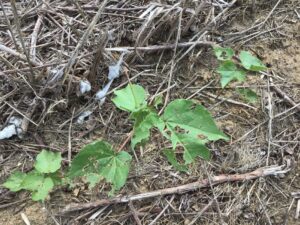
Foliage feeding from Asiatic garden beetle on cotton in the late-vegetative or early-squaring stages
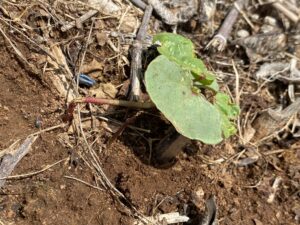
Adult Asiatic garden beetles seem to be particularly sensitive to in-furrow insecticides, such as AgLogic. Often scouts will notice dead adult beetles that fed on cotton plants in fields treated with these insecticides. The beetles must feed on foliage to become intoxicated. However, even though there may be numerous dead beetles, feeding can still be significant. We are collaborating on a 2026 at-planting trial for this insect, but don’t have results yet.
Data courtesy of Dr. Sean Malone, VA Tech
Link to Original Article: https://cotton.ces.ncsu.edu/news/scout-for-foliage-feeding-from-asiatic-garden-beetle/