

SEBE BROWN
JACKSON, TENNESSEE
Plant bug numbers are increasing across the landscape, and squaring applications are right around the corner. Silking corn, blooming soybeans, and flowering weeds all contribute to large increases in plant bug populations that eventually move into both ThryvOn and non-ThryvOn cotton. ThryvOn’s Bt trait can help reduce the amount of injury plant bugs inflict on squaring cotton, but adult plant bugs – especially when present in large numbers – can still knock squares off ThryvOn cotton just as they do conventional varieties. I have seen ThryvOn cotton go from more than 90% square retention to less than 50% in only five days due to a sustained migration of adult plant bugs. The greatest benefit we consistently see from ThryvOn is a reduction in immature plant bug populations during bloom. Even so, ThryvOn typically maintains better square retention than non-ThryvOn cotton throughout the fruiting period. Continue to scout both technologies carefully and do not ignore migrating adult plant bugs.Also, many of the newer varieties begin squaring on the 5th or 6th node, and we need to quickly transition from scouting for thrips to scouting for plant bugs.
Based on previous years’ data and field reports, 2.0 oz/a of Centric was adequate on plant bug populations, but not stellar. Although it is the same class of chemistry, imidacloprid’s performance is fair at best, and recolonization often happens quickly after an imidacloprid or Centric application. I try not to recommend consecutive applications of neonics due to efficacy falling off after the first shot. However, consecutive shots of neonics may be warranted for several reasons (cost, presence of mites, personal choice, etc.), and on the second application I tend to increase rates of Centric to 2.5 oz/a, especially if it was used previously. After the second application, we’ve pretty much exhausted that chemistry. Other options are:
Acephate: Very effective, inexpensive, but carries a high risk of flaring mites and aphids.
Vydate: Effective at killing plant bugs but has limited residual activity, roughly 36 hours.
Bidrin: Not labeled for plant bugs between first square and bloom.
Transform: Very effective, expensive, and does not flare mites or aphids.
Vertento: Syngenta’s new product; very effective, expensive, controls spider mites and stink bugs, but flares aphids similarly to acephate. It may have a better fit after bloom.
Diamond: Very effective on immatures (the smaller the better), requires an adulticide, can flare spider mites and aphids, and is best positioned at first bloom.
The 2026 season marks the first year Vertento is commercially available. The product controls all major species of plant bugs, stink bugs, thrips, and spider mites that we encounter in Tennessee. In my non-ThryvOn cotton trials, Vertento has provided exceptional residual control, keeping plant bug populations below threshold for three to four weeks. The product requires a surfactant. Any quality surfactant will work, although we have generally observed a slight advantage with COC compared to NIS. At approximately $18–20 per acre, Vertento is not inexpensive. However, when considering its broad pest spectrum and residual activity, I believe its best fit is during peak bloom (second to third week of bloom). Vertento is non-systemic and only weakly translaminar. Applications made during squaring will control existing plant bugs, but rapidly growing cotton can outgrow much of the residual activity you are paying for. Applications during peak bloom allow growers to maximize control of plant bugs, stink bugs, and spider mites while taking full advantage of the product’s extended residual activity. In many situations, a well-timed application may help carry a field through the remainder of the season with minimal or no additional insecticide inputs.
Final note: I always receive a few questions about squaring cotton having poor square retention when very few or no plant bugs are found during scouting. Adult plant bugs, especially at this time of year, will move in and out of cotton quickly. The abundance of alternative hosts facilitates movement in and out of cotton without colonization. The take-home message is that, since most people are scouting only once a week, it is prudent to be more aggressive with applications and not risk square retention falling below 80% if you’re close. Monitoring square retention is one of, if not the, best ways to determine whether early-season treatments are working. Migrating adults can give the impression of an insecticide failure, but maintaining good square retention is a strong indication that treatments are working. ∆
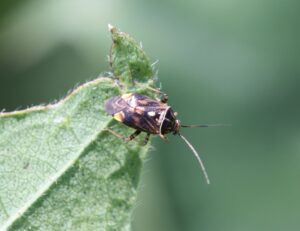
Adult tarnished plant bug
SEBE BROWN
JACKSON, TENNESSEE