

Drs. Phillip Roberts & Alana Jacobson
Luke Crosson / UGA Extension Lee County
We are in a better position today concerning cotton jassid compared to where we were a year ago. To date, we have detected jassids in 18 counties in Georgia in 2026. This time a year ago (August 7, 2025) we had detected jassids in 33 counties. Jassid populations where we detected them a year ago were also present at much higher populations than now.
We currently maintain a map of jassid detections online at: https://stop2scl.org/cotton/. As of today, no jassids have been found or reported in Calhoun County.
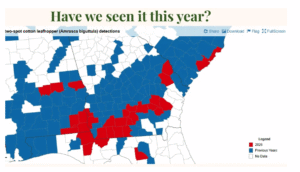
There is no question that the cold temperatures significantly reduced jassids across Georgia. In February, a hard freeze occurred over most of Florida that likely reduced jassid populations to the southernmost part of Florida. Initial detections were likely migrating adults which moved in on wind currents. Perhaps 2026 is a best case scenario for jassid as we move forward, but who knows.
We have received a few reports of early hopperburn on field edges and skips in fields. As we move forward, scouting is a must and we should all be looking for hopperburn and leaf puckering symptoms. We did receive a report this week (August 4th) that a field exceeded threshold for jassid in southeast Georgia. In 2025, the first commercial field treated for jassids was on July 31st, but at that time our threshold was much higher than the 1 jassid per leaf threshold we are recommending for 2026.
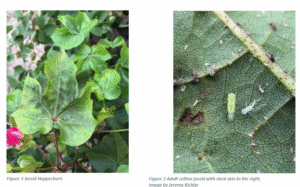
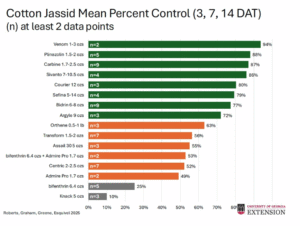
When scouting for jassids, examine the 4th expanded main stem leaf below the terminal. Sample this leaf on a minimum of 25 plants per field (sampling more leaves is better). If jassids reach an average of 1 jassid per leaf, treatment is recommended. Once the threshold is triggered it will be important to make a timely application. As we learned in 2025, jassid numbers and plant injury can progress quickly. If a grower struggles to be timely with an application, you may need to be more aggressive if populations are building. The chart below is a general guide of expected efficacy of insecticides we tested in the southeast during 2025. Some insecticides were tested more than others (i.e. Carbine has 9 data points, Venom only has 2 data points) so we cannot make direct comparisons. But this chart does have value. We interpret this chart that insecticides highlighted in green would be used if jassids triggered threshold. Products in orange provide suppression but may be of value if a grower cannot come back and make a timely application based on scouting. It is also important to note that bifenthrin will not provide control of jassids.
Don’t overreact when you detect jassids, scout and use thresholds, and watch trends of how fast populations are building. All this will allow you to make a good decision. As in 2025 we will be providing regular updates of the most current information.
Silverleaf Whitefly Management
Invariably there will be fields which require intervention of insecticides for Silverleaf Whitefly (SLWF). The goal is to initiate control measures just prior to the period of most rapid SLWF population development (i.e. reproduction in the field). It is critically important that initial insecticide applications are well timed. If you are late with the initial application, control will be very difficult and expensive in the long run. It is nearly impossible to regain control once the population reaches outbreak levels.
-
SLWF Threshold: Treat when 50 percent of sampled leaves (sample 5th expanded leaf below the terminal) are infested with multiple immatures (= 5 per leaf).
-
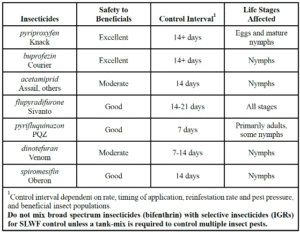
Insect Growth Regulators (Knack and Courier): use of IGRs are the backbone of SLWF management programs in cotton. Effects on SLWF populations are generally slow due to the life stages targeted by IGRs, however these products have long residual activity and perform very well when applied on a timely basis.
-
Use of other insecticide options (non-IGRs) which have quicker effects on SLWF infestations would be preferred if you are late with the initial spray. These quick knockdown sprays will allow you to “catch up” and can be followed by an IGR.
-
SLWF is an areawide cross commodity problem. When everyone uses an effective management program (regardless of crop) all will benefit.
The table below provides some general information on SLWF recommended insecticides:
Luke Crosson / UGA Extension Lee County
Link to Original Article: https://site.extension.uga.edu/irwinag/2026/08/cotton-silverleaf-whiteflies-and-jassid-update/