

ANA MORALES-ONA SMITH, DR. GERSON DRESCHER, DR. TRENT ROBERTS AND DR. ZACH TREADWAY
FAYETTEVILLE, ARKANSAS
Quick Takeaways
- On Potassium (K) deficient soils, unfertilized cotton may produce only 35% to 79% of its potential yield.
- K deficiencies can reduce yield before visual symptoms develop.
- Tissue testing is most useful between first square and approximately three weeks after first flower.
- Petiole samples provided a more reliable indicator of cotton K status than leaf blades.
- Sample the petiole from the uppermost fully expanded leaf (typically the 3rd or 4th node from the top).
- Target petiole K concentrations are about 4.7–4.8% during squaring and early flowering.
Potassium (K) deficiency remains a leading yield-limiting factor in Arkansas cotton production. Because modern, early-maturing cultivars demand high levels of K early in the season, relying on visual symptoms for diagnosis is a risky strategy. Recent research from the University of Arkansas Division of Agriculture has defined new, growth-stage-specific benchmarks to help growers use tissue testing more effectively.
Don’t wait for visual symptoms
One of the greatest challenges with K is “hidden hunger”, which is a condition where the plant appears healthy but is already suffering from low K levels that reduce growth and yield potential. By the time visual symptoms like interveinal chlorosis (yellowing between leaf veins) appear, yield potential may already be lost. Potassium deficiency symptoms can develop in lower leaves during squaring and may later progress into the upper canopy during flowering as crop demand increases (Figure 1). Research shows that on K-deficient soils, unfertilized cotton may produce only 35% to 79% of its potential yield and compromise lint turnout and quality (such as fiber elongation, lint uniformity, and strength).
When and how should you sample?
The most effective sampling window extends from first square through approximately three weeks after first flower. During this period, tissue-K concentrations are most closely related to yield potential. As the crop progresses into late boll development, tissue test results become less predictive of crop performance.
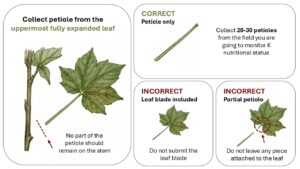
For in-season K monitoring, collect the petiole from the uppermost fully expanded leaf (typically the third or fourth node from the top of the plant) (Figure 2). Potassium concentrations in petioles are nearly five times higher than in leaves, making it easier to detect changes in the plant’s nutritional status. Collect 20-30 petioles from the field you are going to monitor K nutritional status. Place the petiole samples in a labeled paper bag to allow them to dry, then submit for tissue analysis.
What K levels should you target?
Potassium levels in cotton are dynamic, peaking at the first square stage and naturally declining as the plant shifts its energy toward developing bolls. To maximize yield, growers should aim for these specific tissue-K benchmarks:
What if tissue-K levels are below the benchmark?
Corrective action should be considered during the window from first square through the first three weeks of flowering. Approximately one-third of the plant’s total K uptake occurs during the two weeks immediately following the onset of flowering. Identifying and addressing a deficiency before this peak demand period (roughly 63 to 77 days after planting) is essential to protecting yield potential.
In Arkansas K fertility research on cotton shows that total seasonal rates (preplant + in-season) exceeding 120–140 lb K2O/acre do not provide statistically significant benefits. Rescue applications should aim to bring the crop toward these proven yield-maximizing levels without entering “luxury consumption”. For moderate K deficiencies during squaring and the first week of flowering (4.2-4.7% petiole-K), 30 lb K2O/acre should be applied. For more severe K deficiencies (≤4.1% petiole-K), up to 60 lb K2O/acre may be required. Proper correction of macronutrient deficiencies, such as K, requires soil-applied granular fertilizers due to the amount of nutrient required to recover yield potential. Soil-applied granular muriate of potash (0-0-60) is the best approach to correct in-season K deficiencies in cotton.
Future work
Future research will focus on refining in-season K management recommendations, including application rates and strategies for correcting deficiencies detected through tissue testing. The goal is to move beyond diagnosis and provide growers with practical, data-informed recommendations for in-season K management. ∆
ANA MORALES-ONA SMITH, DR. GERSON DRESCHER, DR. TRENT ROBERTS AND DR. ZACH TREADWAY
UNIVERSITY OF ARKANSAS
Figure 1: Early-season K deficiency in the lower leaves of cotton plant (A), severe K deficiency at the top of the plant during flowering/boll development (B), severe K deficiency during mid-late reproductive development (C), and severe K deficiency resulting in early-leaf senescence (D) in soil with very low K availability without K fertilization.
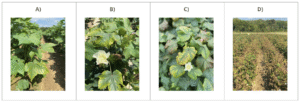
Figure 2. Proper petiole collection for cotton potassium tissue testing. Sample the uppermost fully expanded leaf, remove the entire petiole from the stem, and submit only the petiole for analysis. Avoid including leaf blades or partial petioles.
Link to Original Article: https://arkansascrops.uada.edu/posts/fertility/k-testing-cotton.aspx