

KEN LEGE
TEXAS
Persistent dryness across West Texas through April and early May raised significant concerns about timely cotton planting and final acreage. With crop insurance deadlines set at May 31 for the Panhandle down to Plainview, June 5 around Lubbock, June 10 further south, and June 20 across the southernmost production areas, many producers anticipated challenges in getting the crop established.
In the Panhandle region (north of I‑40), some producers initiated planting under irrigation in late April through early May. A subsequent cold spell resulted in freeze injury, prompting replanting in some cases, often to alternative crops such as corn or sorghum. Meanwhile, growers north of Lubbock up to Tulia began dry planting both dryland and irrigated fields, relying on forecasted precipitation to support stand establishment. For a period of seven to 10 days, prospects appeared poor.
Conditions shifted beginning May 15-20, when widespread rainfall arrived alongside generally favorable temperatures. Producers who dry planted were largely rewarded with adequate moisture for stand establishment, while those who delayed planting were able to capitalize on timely rainfall to cover intended acreage. South of Lubbock, rainfall has been especially well-timed, contributing to strong early season crop development.
Notably, weather-related damage has been minimal to date — an uncommon occurrence during spring in West Texas, where high winds, intense rainfall, and hail typically accompany storm systems. Instead, recent precipitation has been steady and non-destructive. As of early June, cotton stands across the region appear above average, with newly planted fields benefiting from additional rainfall.
The first major agronomic challenge of the season is now emerging: weed control. Prolonged pre-plant dryness limited activation of many pre-emergence herbicides, resulting in inconsistent and reduced efficacy. With the onset of rainfall has come a significant flush of weeds, intensifying the need for timely management.
Volunteer cotton has proven particularly problematic this season, especially in fields where the current crop has already emerged. Compounding this issue, dry winter and early spring conditions hindered cover crop establishment. In some 80-inch drip irrigation systems, where drip lines are positioned between alternating cotton rows, cover crop growth has been sparse and largely confined to the drip line itself (see accompanying picture). These thin stands have provided insufficient suppression of weeds and have offered limited protection against wind erosion.
As a result, some producers have had to invest in mechanical solutions, including sandfighters and plows, to mitigate erosion risks due to inadequate cover crop biomass.
Despite these challenges, the outlook remains cautiously optimistic. Continued chances for rainfall in the forecast are encouraging and will be critical for sustaining crop development. While early conditions are favorable, the ultimate success of the 2026 cotton crop will depend on continued precipitation and effective management in the weeks ahead.
Additional information, including 2026 RACE trial maps, is available at:
https://lubbock.tamu.edu/programs/crops/cotton/extension-cotton-agronomy/ or through your local Extension agent. ∆
KEN LEGE
TEXAS
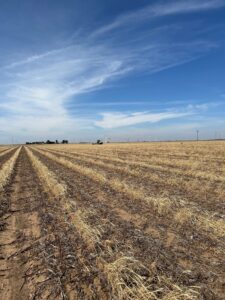
PHOTO CAPTION — Lege said that over crops were difficult to establish in West Texas in 2026 due dry winter and early spring conditions. Shown here is an 80” subsurface drip field where the cover crop emerged and established only near the drip lines between alternate rows of cotton.