The Cotton Research & Promotion Program, funded by U.S. cotton growers and importers, continues to invest in research aimed at improving producer profitability. One area receiving increased attention is precision agriculture technology, particularly tools that can help reduce input costs while maintaining effective weed control.
While technological advances in cotton production are happening rapidly, evaluating how well these technologies perform under real-world field conditions is critical. That’s where on-farm research, funded by Cotton Incorporated, plays an important role.
Kansas State University master’s student Igor Gustavo Rezende Lima, working with Dr. Sarah (Lancaster) Ganske, Assistant Professor and Extension Weed Science Specialist at Kansas State University, recently conducted an on-farm evaluation of targeted herbicide applications compared to traditional broadcast spraying.
Previous research in soybeans has shown that targeted postemergence herbicide applications can reduce spray volume by 28–62 percent while still maintaining about 94 percent weed control. Lima and Ganske set out to determine whether similar results could be achieved in cotton production systems.
Two cotton field trials were established near Pratt and Burrton, Kansas, to evaluate weed control, crop injury, and yield under different herbicide application strategies. Researchers compared three different approaches: traditional broadcast spraying, a dual-tank system using both targeted and broadcast applications, and a single-tank targeted spraying system.
All three treatment strategies used the same herbicide products: 2,4-D, glufosinate, and glyphosate, along with a pre-emergence herbicide program. The difference between treatments was simply how the herbicides were applied.
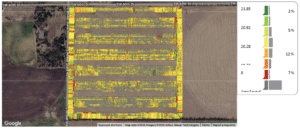
Each trial covered between 6.3 and 6.8 acres per treatment and was replicated four times across the field. Applications were made in 120-foot passes using John Deere See & Spray™ Ultimate sprayers, which are designed to detect weeds and apply herbicide only where it is needed.
Before each herbicide application, researchers collected field data including pigweed counts, cotton height, plant nodes, and chlorophyll content using a SPAD meter. Weed control and crop injury were also recorded weekly for three weeks after spraying and before harvest to monitor weed control and crop response.
Across both locations, weed control was strong for all treatment strategies. As seen from the graphs, weed control levels exceeded 80 percent in all treatments, with only the single-tank targeted strategy showing some decline after week three in Burrton and week two in Pratt.
One of the more interesting findings came from the Burrton location, where the single-tank targeted spray system actually treated only about 51 percent of the field area. That suggests there may be opportunities for producers to significantly reduce herbicide use and associated input costs when using targeted spraying technology.
Researchers also evaluated crop injury following herbicide applications. Broadcast spraying resulted in the highest level of visible plant injury, ranging from about 5 percent to nearly 15 percent during the first week after application. By the third week, injury levels had declined to around 5 percent. In contrast, targeted spraying systems generally resulted in plant injury of 5 percent or less.
“The dual-tank system can easily use targeted spraying for effective weed control while producers are also applying insecticides or plant growth regulators,” Lima explained. “The single-tank targeted strategy was also very effective, and we saw less plant injury.”
Yield data were collected to determine whether differences in herbicide application strategy and plant injury could affect yield and quality.
At the Burrton location, yields were similar across all treatment strategies, suggesting that even though weed control was strong across treatments, it did not translate into measurable yield differences. Researchers noted that late-season weed escapes or environmental stress may have influenced the crop’s overall performance.
The Pratt location told a slightly different story. Yields in the single-tank targeted treatment were approximately 60 percent higher than those in the broadcast and dual-tank treatments. However, the field experienced storm and hail damage during the boll-fill stage, which likely influenced overall yield outcomes.
Researchers believe that reduced spray stress throughout the growing season may have contributed to the yield differences observed in the targeted application treatment. Additional analysis is still underway. Lima is currently evaluating lint and seed quality for each treatment, along with a full economic analysis of the different application strategies.
“We are looking forward to lint and seed quality evaluations, as well as an economic analysis, that will be coming forward this spring,” Lima said.
Dr. Ganske believes the research highlights promising opportunities for cotton producers as precision spraying technology continues to develop. “Through these trials, we have shown the ability to reduce herbicide volumes, keep the fields’ weed population in control like broadcast spray applications while making fewer trips across the field,” Ganske said. “That’s time and dollars saved.”
Southern Plains research like this, funded through the Cotton Research & Promotion Program, continues to provide cotton producers with practical information to help guide technology adoption and improve profitability on the farm.
Performance
Application Time: 44 min Speed: 10.4 mi/hr
Pressure: 43.9 psi Productivity: 143.2 ac/hr
Total Fuel: 4.4 gal Fuel Rate (Area): 0 gal/ac Fuel Rate (Time): 5.9 gal/hr