Grassroots Effort: ROLLIN’ FOR U.S. COTTON EMPHASIZES ‘PLANT NOT PLASTIC’
By Carroll Smith
Contributing Editor
Frustration regarding the marketing of American cotton was a recurring topic in the Bogue Chitto Cotton Gin boardroom and among its producers, according to Aaron Litwiller, general manager at the Noxubee County, Mississippi-based facility.
For Rodney Mast, one of Bogue Chitto’s board members, stockholders and cotton farmers, farming has always been a family affair. He recalls going into partnership with his dad in the 1990s and about 2012 bringing in cousin Lowell Mullet.
“In 2017, Lowell and I bought out my dad and a few years later, Josh — one of my sons — came in as a partner,” Mast said.
Today, the three men farm cotton and corn and gin their cotton at Bogue Chitto Gin with Litwiller.
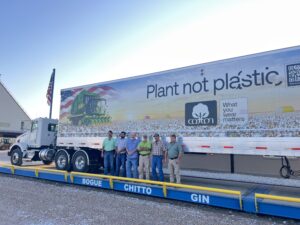
 “This past May, Rodney sent me a picture he had created with artificial intelligence (AI),” Litwiller said. “He said, ‘Boy, wouldn’t it be cool to see this wrapped on a trailer going up and down the highway — kind of a moving billboard promoting American-grown cotton.’ I loved the idea.”
Mast said he hatched the concept this spring while spending 18-hour days riding back and forth across the field on his planter.
“I was thinking about cotton and how to increase pricing,” he said. “I don’t know why I had the idea, but I thought seeing trucks running up and down the road promoting cotton would be great. It’d be the right time of year while we’re ginning and people are buying Christmas gifts. We could hit them with the message that cotton is what they want. So I thought, well, let’s just put that wrap on the trailers.”
The cotton farmer’s “aha” moment led to setting in motion a grassroots movement to enlighten consumers and give cotton farmers a chance to help themselves make more money for their product.
“If we can get this trailer wrap on trucks all across the Cotton Belt, it could make a significant difference,” Mast said.
A Message That Resonates
“The same day I got the picture from Rodney, I had a conversation with Joe Huerkamp — another one of our farmers, stockholders, and board members,” Litwiller said. “He loved the idea so much that he told me to work on getting the trailer, and he would work on getting support for the project. The cotton industry vendors he called were all excited, and many felt this type of marketing was long overdue.
“But when my wife, Kimberly, and I started working on refining the art for the trailer wrap, we found out the AI picture wasn’t high enough quality to be blown up.”
This predicament prompted the couple to start working with a graphic design artist to correct the photo’s format. They also solicited “messaging” input from the farmers who were involved in the project as well as some friends of theirs from up North who knew nothing about cotton to decide on the best “messaging” to include on the wrap. This was important because today’s consumers are inquisitive, and the message must resonate with them for U.S. cotton producers to successfully market their cotton.
“That message was what we wear matters, Plant Not Plastic, which is the name of the National Cotton Council’s public awareness campaign,” Litwiller said.
Mast added that he showed the final photo to several ladies because they do a lot of the clothes purchasing and so forth.
“I let them look at the photo for about 10 seconds and then pulled it away and asked them what they saw,” he said. “And they’d say, ‘Well, I saw a cotton picker and a cotton field and plastic, but there was something wrong with the plastic.’
“They got it. In today’s environment, we’re not only thinking about our comfort but also our health. There is plenty of information out there talking about the potential problems we face from all the plastic we are around.”
A Family Steeped In Cotton
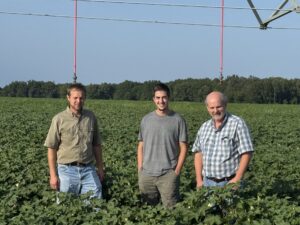
In the 1960s, Frank Huerkamp moved to east Mississippi from Ohio and bought 1,000 acres of farmland. Not being familiar with growing cotton, he partnered with the man from whom he bought the farm for several years while he got his feet under him as far as learning about this new crop. Today, two of his sons — Jack and Joe — farm cotton and corn in Noxubee County near Macon with their sons Brandon and Tyler, respectively.
“Jack and I grew up playing in cotton wagons, following the help around and bothering them and enjoying everything else young kids do on a cotton farm,” Joe said. “All together, there were five siblings — three brothers and two sisters — and we all helped with the farm. We are very steeped in cotton.”
When Joe heard about the trailer wrap project, he thought it was a fantastic idea.
“The large QR code that appears on the wrap will direct people to all the facts about cotton vs plastic,” he said. “Maybe we can sell a couple more million bales of cotton, which is what we want to do. We’d like to see these wrapped trailers traveling across the country from the Carolinas to California.
“Our goal is to get gins to put it on a truck or two to help American cotton get the exposure and increase sales. We want people to understand the difference between polyester — a manmade fiber — and cotton, which is a natural fiber. Rodney Mast really came up with a great idea. We’re also excited that USDA has come out in support of Plant Not Plastic.”
 USDA Steps Up
According to a May 28 press release, U.S. Secretary of Agriculture Brooke L. Rollins announced the Great American Cotton Plan, a comprehensive USDA initiative to strengthen the cotton farm economy, restore domestic textile manufacturing, expand cotton trade opportunities, and increase demand for products made with American-grown cotton.
“Since 1607, cotton has helped build and sustain rural America,” said Secretary Rollins. “Our farmers grow some of the highest-quality cotton in the world, but over the past several years America’s cotton growers have been crushed by rising costs, unfair foreign competition, and a flood of cheap synthetic products.
“In 2023, we lost our status as the world’s top cotton exporter to Brazil. This change starts today. The Trump Administration is committed to ensuring American cotton once again becomes the fiber of choice with the Great American Cotton Plan — a bold effort to restore profitability for cotton producers, strengthen rural economies, rebuild domestic textile manufacturing, and bring American cotton back into the products families use every day.
“Supporting natural fibers like cotton also aligns with the Make America Healthy Again agenda as Americans grow increasingly concerned about microplastics and synthetic materials in everyday products. Cotton is natural, breathable, biodegradable, and proudly grown by American farmers — not manufactured from petroleum-based plastics that can shed microplastics into our soil, water, and bodies.”
The release also notes that “the cotton industry continues facing severe economic pressure. At the same time, nearly 70 percent of the world’s textile fibers are now synthetic, most of them plastic-based materials such as polyester.”
The Great American Cotton Plan addresses these challenges through four key pillars:
-
Promoting Domestic Cotton Consumption
-
For example, USDA and the U.S. Department of Health and Human Services (HHS) are promoting the “Plant Not Plastic” initiative to encourage consumers to choose products made with American cotton.
-
Providing Affordable Cotton By Increasing Domestic Demand And Production
-
Protecting Cotton Growers From Adverse Risk
The announcement closes by saying, “USDA will continue coordinating with industry stakeholders, manufacturers, cotton growers, retailers, and Congress to advance policies that strengthen the cotton supply chain from the field to the fabric.”
And back in east Mississippi, the Plant Not Plastic trailer wrap project born in one cotton farmer’s planter cab hopefully will continue to grow and spread from Bogue Chitto Gin all the way across the Cotton Belt. Everyone’s invited to get on board
How To Be Part Of This Grassroots Movement
-
If you want to wrap a Plant Not Plastic trailer and roll for U.S. cotton, the first step is to contact Aaron Litwiller at Bogue Chitto Gin to request the free image. Email him at [email protected]. “The only requirement we have is to keep the photo as is and not add anything like logos to it,” Litwiller said.
-
The next step is to contact a vendor to produce and apply the wrap, which is a pretty common procedure. “We used Fast Wrapz in Tupelo, Mississippi,” Litwiller said. “They made it onsite at their business and hung it somewhat like wallpaper in four- or eight-foot sections. The cost is typically between $6,500 and $7,000 per trailer.”
-
To help offset the cost, tap some of the cotton vendors who may be interested in having an opportunity to tell the story of cotton vs polyester. “In our case, when Joe Huerkamp called around, these people got behind it, so we didn’t have to foot the whole bill,” Litwiller said.
“I think the cotton vendors will do this in other places, too. They see the value in this effort and recognize that if cotton takes off, it’s going to be good for everybody involved. We feel it’s time the gloves came off, and we landed some blows on the reality of the negative effects of microplastics.”
Campaign Highlights Clothing’s Role In Microplastic Pollution
A national survey conducted by Cotton Incorporated for the National Cotton Council (NCC) in 2025 reveals consumers are in the dark about microplastic pollution, particularly its origins in everyday clothing, according to a press release from the NCC.
“Our research clearly indicates that while consumers are concerned about microplastic pollution, they are largely unaware of the significant role their clothing can play in this issue, and crucially, they don’t know what specific actions to take,” said Marjory Walker, Vice President of Council Operations, NCC.
“The survey revealed that ‘lack of clear information/guidance’ (34%) and being ‘unsure what specific actions to take’ (32%) are the biggest barriers preventing consumers from taking more action. This isn’t about apathy; it’s that people aren’t sure what actions will make a difference.”
The survey also emphasized the rising level of public interest for human health impacts, increased by recent scientific discoveries.
“When consumers realize that the tiny plastic fibers shedding from their clothes can end up in the food they eat, the water they drink, and even within their own organs, the issue becomes incredibly personal,” Walker added. “This direct health dimension is a powerful motivator, but it also amplifies the need for clear, actionable solutions that empower individuals to protect themselves and their families.”
In light of these findings and the growing need for clear consumer guidance, the NCC launched a public awareness campaign: “Plant Not Plastic.” This initiative intends to bridge the knowledge gap by educating consumers on the importance of choosing natural fibers in their clothing to reduce microplastic pollution and its potential health implications.
“The ‘Plant Not Plastic’ campaign is designed to provide a straightforward message: choosing clothing made from natural fibers like cotton is an easy, effective way to reduce your personal contribution to microplastic pollution and its potential health impacts,” Walker explained. “We want to empower consumers to know their clothing choices can make a real difference, simply and affordably.
“We believe that by providing clear, actionable information through the ‘Plant Not Plastic’ campaign, we can empower consumers to make informed choices that benefit both their health and the environment. It’s time to shift from confusion to confident action, one natural fiber garment at a time.”
To learn more about the Plant Not Plastic campaign, go to plantnotplastic.org and follow Plant Not Plastic on social media platforms: Instagram, Facebook, and X.
# # #