

Sonder Farms
Texas Brothers Bet Heavily On Cotton In The Brazos Bottom
CARROLL SMITH / BRAZOS BOTTOM, TEXAS
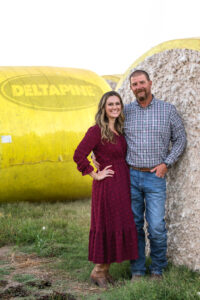
Mac Kutzenberger and his wife, Danielle.
The Texas Brazos Bottom is the historic Brazos River floodplain known for its fertile land that’s as rich as the Goode Co.’s famous Brazos Bottom Pecan Pie.
Although Mac Kutzenberger farms in the Brazos Bottom today, his story began in the Rio Grande Valley where he and his brother, Kyle, were born and raised. Their grandfather and father grew citrus, row crops, and vegetables before they sold out when Mac was in high school.
“I started working on my best friend’s farm in the Rio Grande Valley, and then my brother and I moved to College Station, Texas, in 1997 and fell right back into agriculture,” Mac said. “We started our own agriculture business in 2001 doing custom tractor work and row crop spraying that eventually evolved into custom harvesting.”
Mac and Kyle worked hard in the Brazos Bottom, which ultimately led to opportunities to start renting land and begin farming on a small scale as partners. What began as a modest operation in an area blessed with loamy, dark soil has grown to a little more than 10,000 mostly irrigated acres of cotton, corn, milo and a few soybeans. Today, the main entity is known as Sonder Farms.
2025-26 Cotton Variety Choices
“The main cotton varieties we planted in 2025 were DP 1646 B2XF and DP 2541 B3XF,” Mac said. “I know 1646 is an older variety, but it’s a workhorse in our area, has a great fiber package and is also forgiving. It’s my go-to. We have a lot of irrigation, so if we get a little bit behind, it will kick off again. Because 1646 has the older Bt technology, I just budget for a worm spray as part of my program.”
The Texas farmer said one of the challenges of 2025 happened when the young cotton was subjected to hail and strong winds, and they had to decide whether to replant. In the end, Mac said, about 4,000 out of 4,600 cotton acres were replanted, and the amount of cotton they produced in 2025 was phenomenal. Although he had planted some 2541 in the beginning, it got hailed out and was replanted with 1646.
“At the end of the year, everyone asked me if I was glad I replanted, and I said, ‘Absolutely.’ As far as rainfall, Mother Nature blessed us, so we had a really good season in central Texas. For the past couple years, we’ve had no rainfall at harvest time, so our grades have been good, too. We’ve been blessed.
“In looking back, 2025 was one of those years where I leaned heavily on 1646,” Mac said. ‘But, I know that eventually it’s going to go away. So, being a Deltapine New Product Evaluator (NPE) producer, is very valuable to me because I get to look at the genetics and see what’s coming for the future. It’s nice to see what works and what doesn’t in areas similar to ours.
“The beauty of NPE is getting to experiment with all these varieties. In 2025, we tested an NPE variety that is coming out this year as DP 2635 B3TXF. That’s a variety I’m definitely looking forward to seeing on a larger scale this year.
“In 2024, DP 2541 B3XF won my particular NPE plot. I’ve got it slated for this year and will lean pretty heavily on that variety. It’s got a good fiber package and good vigor. Those are the kind of things you look at when choosing varieties.”
In 2026, Mac says he is going with DP 2541 B3XF, DP 1646 B2XF, and DP 2131 B3TXF.
“From what I have heard, there’s another variety that did really well in the NPE trials — DP 2525,” Mac said. “It has an amazing fiber package. I’m going to try some of that variety on a small scale to see how it does in our area.”
Precision Technology
When it comes to equipment, Sonder Farms “bleeds green.” Everything is John Deere.
“Their technology is amazing,” Mac said. “I outfitted a John Deere planter for precision planting that includes things like instantaneous moisture, soil temperature, organic matter and Cation Exchange Capacity (CEC). The planter can adjust the planting depth, which helps me stay between the range of no less than a half-inch and no more than an inch or an inch and a quarter.
“With this technology, we’ve been able to go away from hill drop planting we used to use to help the cotton plants push through crusted soil. These smart planters also allow me to log in on my iPad and see in real time exactly what the guy planting is seeing in the cab on the monitor.”
Mac said they also have incorporated precision technology into their fertility program.
“When you consider input prices and commodity prices, you’ve got to stay on top of your farm to make sure every penny spent is a penny that matters,” Mac said.
Weed and Insect Pressure
Farmers blessed with rainfall and ample moisture can produce bountiful yields but also be faced with a good environment for weeds. Johnsongrass, Texas panicum, and giant ragweed are common culprits, but the main pest Mac deals with is carelessweed, or Palmer amaranth.
Mac said he compensates for not having the ability to spray dicamba by adjusting his weed control program and putting out more pre-emerge herbicides in the fall and winter.
“We cross our fingers that dicamba will be approved for use this season, but the nice thing about having different traits in the Deltapine products is having other herbicide options, such as Liberty.”
In the insect arena, the boll weevil has pretty much been eradicated, but there is still early pressure from thrips and aphids and some spider mite hotspots later in the season.
“When planting a Bollgard 2 variety, we always take a hard look at bollworms and budworms,” Mac said. “Our entomologist, V.V. Turner, has been checking our cotton for years. He’s out here from planting to harvest and plays a very vital role. I enjoy learning from him.
“Last year, we had 4,600 acres of cotton, but we knew we wouldn’t have to spray all of it for worms. We typically watch for an egg lay to come in, proactively get the chemicals situated at the airfield, and then roll the dice to calculate when everything should be hatched. Deciding when to pull the trigger is a gamble and a risk, but we’ve gotten pretty good at it, so we are able to take care of the worms with one shot.”
Harvest Time Logistics
After in-season production wraps up and the pickers have rolled across the fields, Sonder Farms cotton heads to the next stop — B F & M Co-op in Rosebud, Texas. Kyle Kutzenberger sat on the board of directors for six years, and Mac was elected to his second six-year term in 2025.
“B F & M is a ways from where I actually farm,” Mac said. “It’s in close proximity to Temple, Texas, but we have 18-wheelers that allow us to haul all our own cotton to the gin. We run four John Deere round bale pickers and stage our cotton where it’s accessible even during a rain.”
To accomplish this feat, the modules are placed on an oil pad or in a corner of the field that has a gravel road close by. Even in adverse weather, they can continue to haul their cotton, which ensures the gin can continue to run.
At the End of the Day
“As a cotton farmer, you learn something new every day whether you want to or not,” Mac said. “It’s an amazing crop and a little bit of an obsession. My family inspires me to get up every day and give it my best.
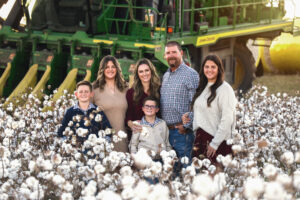
Mac Kutzenberger and his wife, Danielle, are joined by their twin daughters and two sons. From left are Mason, Macie, Danielle, Myles, Mac and Marlie.
“Just being out at the farm to see every sunrise, every sunset and successfully work through all the challenges of growing cotton is satisfying to me.” ∆
CARROLL SMITH / CONTRIBUTING EDITOR