

Specialists Speaking – Dr. KEN LEGE TEXAS
Stand establishment is a challenge no matter where you are in the U.S. cotton belt, but since West Texas’ most limiting resource is water, achieving a healthy stand can make or break the season. Seed accounts for 6% to 14% of total variable costs for a cotton crop in West Texas, and one of the most often asked questions I get revolves around seeding rate: “How low can I go (…and get away with it!)?” We can achieve good yields with scarily low plant populations, but it is rare and highly dependent on knowing the seed quality of the lot(s) you have purchased, planting when conditions are optimal (which happens rarely in west Texas due to our erratic weather patterns), and when fields have been properly prepared.
High quality seed and good seed placement are key to establishing a uniform stand of cotton — uniform in spacing and uniform in plant age is the goal, regardless of the desired plant population. With support from the Cotton Board/Texas State Support Committee (25-434TX), our program has preliminary data regarding plant age uniformity down the row. Having non-uniformly aged plants in the same stand can reduce yield significantly. In many cases, plants that emerged two to three weeks after the remainder of the field (labeled ‘2’ and ‘3’ in the included picture) emerged produced very little or no measurable yield.
West Texas growers experience this when moisture is spotty in a field after planting, or when soil moisture is quickly depleted from the seed zone soon after planting. If another rainfall event or irrigation provides sufficient moisture to germinate the remainder of the seed, this non-uniform plant age occurs. To avoid this situation, growers should carefully adjust planter settings and ground speed to achieve uniform seed depth and coverage and adjust seeding rates with the actual warm and cool germination percentages. However, sometimes despite growers’ best efforts, this non-uniformity may still occur and cause management challenges during the season.
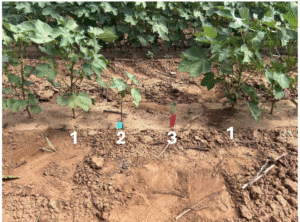
Non-uniformly aged plants within a row in a field experiment in Lubbock, TX. Plants labeled ‘2’ and ‘3’ emerged ~2 and 3 weeks after the plants labeled ‘1’. Photo credit: Riley Siders.
Planting seed will have a tag that reads “80% germination,” which reflects the minimum standard required by state and federal seed laws; however, warm germ will most likely be higher. Additionally, the more important seed quality information to be aware of is the cool germination percentage, which provides a better assessment of seed vigor and a better prediction of field emergence under field conditions. While not required by state or federal seed laws, the industry standard for cool germ is 60%.
Combining the warm and cool germ percentages creates the Cool-Warm Vigor Index (CWVI), which is a very informative guide for the grower regarding seed quality. For example, adding an 80% warm and 60% cool germ equates to a 140 CWVI, which is a very good minimum standard for planting seed and gives the growers lots of options on when and in what conditions to plant that seed. If the CWVI is less than 140, the grower should either increase seeding rate or plant under more optimal conditions to compensate for the lower quality. This may be necessary for new or limited-supply varieties that are a grower’s favorite. How do you get this actual germination percentage data? Simple: call or text your seed company representative or ag retailer with the lot number.
Cotton is very sensitive to cool temperatures. Since most West Texas growers have to wait on a planting rain to plant cottonseed, there are times they are forced to plant when moisture is available, but perhaps under suboptimal temperatures. Chilling injury can result when temperatures at seed depth are below 50 degrees Fahrenheit during imbibition, so always monitor soil temperature (everyone should have and use a soil thermometer!). A good rule of thumb is that the soil temperature at seeding depth will normally be within 1 degree Fahrenheit at dawn, which typically is the low temperature for a 24-hour period. Tracking the forecasted heat units for the next five days following a proposed planting date provides a useful guide to planting. Ideally, at least 26 or more DD60s should accumulate in the next five days to achieve a good stand; 50 or more is even better. We are very fortunate to have the West Texas Mesonet (https://www.mesonet.ttu.edu/) that provides air temperature and soil temperatures at most locations; the mobile app calculates DD60s as well.
“When should I plant?” is likely the second-most-asked question I get. Data from the past few years from multiple sources indicate that later plantings (i.e., early June) Lubbock-southward in the southern high plains have resulted in higher yields and equal fiber quality compared to earlier planting (i.e., mid-late May). Keep in mind that the past few years have been much warmer than average, especially in the fall when we need heat units to fully mature the crop to fully realize yield potential and micronaire development. Planting date trends north of Lubbock and into the panhandle area of Texas are less clear. The best approach is to carefully evaluate predicted air and soil temperatures when you receive a planting rain and gauge that against when the forecast is showing the next chance of a planting rain.
Achieving a good stand of cotton in West Texas is always a challenging task, but growers can prepare by having all the information and tools, most of which are of no cost, to make the best decision when fields receive a planting rain. As with most things in West Texas, moisture is key for stand establishment. ∆
Specialists Speaking – Dr. KEN LEGE TEXAS