SCOTT GRAHAM
Auburn
Good news: After the recent rains, the Thrips Model has totally shifted. For the majority of the state, VERY LOW thrips pressure is expected for anything planted from now through basically all of May. For pretty much the whole state, any cotton planted in May (At least by the 5th) should be at relatively low risk of thrips (for now). Cotton planted in April is at a moderate to high risk (earlier planted, higher the risk). I would expect seed treatments to give us a good chance at outrunning thrips, assuming nighttime temperatures are high enough to keep the cotton growing. Time will tell how things will change.
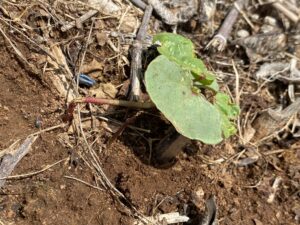
Grasshoppers: We have gotten a lot of calls over the past couple of days on grasshoppers across central and south Alabama. It can be tricky to tell how many are adults or immatures, and most folks don’t carry sweep net in seedling cotton to catch them, but at this point it is safe to assume that a decent percentage of the population is adults. Unfortunately, we do not have good thresholds for grasshoppers. It basically comes down to the level of risk a farmer is willing to take. One thing we have noticed is that fields that grasshoppers have reduced stands in in years past are likely to have it happen again. In some conversations, the grower is willing to accept some risk, but in most cases, they are not.
We are pretty limited with options for control of adult grasshoppers. Acephate (0.67 lbs ai) has been the standard and most consistent option. While some people have asked about pyrethroids, they are just too inconsistent on adults. We have also been asked about Bidrin. While we have not tested it, it would likely provide similar control as acephate as both are organophosphates. The labeled rate for Bidrin on grasshoppers is 3.2 oz.
Thankfully, immature grasshoppers are not as difficult to control. The acephate provides good knockdown control, but short residual. This is why we recommend Dimilin (2 oz) be added to the tank. Dimilin provides good residual control of immatures continuing to hatch in the field.
A few other points: Grasshoppers are not a “border pest.” Eggs are deposited in tubes in soil in the fall and are distributed across the field. Thus, the entire field should be treated, not just the borders. Cotton is most susceptible in the crook stage as the emerging stem is just cracking the soil surface. However, stand loss can be threatened after full emergence as grasshoppers feed on the mainstems.
As always, if we can ever be of any help, or if you would like to provide input on the situation in your area, please don’t hesitate to reach out to your local Extension Agent or myself (Scott Graham: 662-809-3368) and Ron Smith (334-332-9501). For more information on thresholds and insecticide recommendations, visit the Alabama Cotton IPM Guide (IPM-0415). To stay up-to-date on the Alabama cotton insect situation, subscribe to the Alabama Cotton Shorts Newsletter, Alabama Crops Report Newsletter and Podcast, and the Syngenta Pest Patrol Hotline. ∆
SCOTT GRAHAM
AUBURN UNIVERSITY
Image 2. Grasshopper damage in young cotton.
Link to Original Article: https://mailchi.mp/4b5615d2326d/october-4-2019-alabama-cotton-shorts-5758771?e=fed2a809ad