

UNIVERSITY OF GEORGIA EXTENSION – TIFTON, GEORGIA
Ryegrass that cannot be controlled with Roundup has been documented in Georgia, and complaints of Roundup “missing” ryegrass are becoming more frequent. If you see this, be certain to document fields where these escapes are occurring so a sustainable program can be implemented beginning this fall for next season. A successful program for next year would use effective residual herbicides applied in the fall and, ideally, plant a cover crop. To get by with a band-aid approach to planting this year, Gramoxone or Liberty may suffice if you are fortunate enough to have ideal conditions and mature enough ryegrass; unfortunately, seeds will likely be produced. Keep in mind that just because ryegrass does not die from a Roundup application does not mean it has resistance. Other factors can often lead to a lack of ryegrass control by Roundup, including large plants, cold nighttime temperatures, antagonism from tank mixes, and the rate of Roundup being too low. Residual herbicides remain the NUMBER ONE method to help achieve a successful weed management program. However, in dry-land production when rainfall is scarce, activating these tools is obviously a challenge. Dr. Culpepper’s research has noted that products like Reflex can lie on the soil and wait nearly 3 weeks for rainfall and still be very effective on weeds that have not emerged. Warrant also performs quite well with his data, suggesting it can sit on the soil for about 11 days and remain effective; however, many other products, like your yellow herbicides, lose activity in a matter of a few days. Avoiding injury from preemergence herbicides under drought conditions is a major concern, but so is not applying residual herbicides, as the potential lack of weed control can be costly. Regardless, waiting until the cotton emerges before applying herbicides may be the only option for some acres.
If one decides to plant cotton in dry soils without residual herbicides, there are several key points to consider regarding weed control.
- There should be no weeds emerging (especially Palmer) when the cotton seed is placed in dry soil. In theory, if the field is weed-free when dusting cotton in the soil, then no additional weeds should emerge until it rains.
- The first postemergence herbicide application should occur as soon as the cotton is fully emerged; the treatment must kill emerged weeds and must include residual herbicides. The level of selection pressure on the postemergence herbicide in this situation is very high and unsustainable over time.
- A second postemergence herbicide application should be made 12 to 15 days later and should again include a residual product; this timing assumes you were timely with the first postemergence application. If you were not timely, the interval needs to be shortened following label recommendations.
- The value of the layby application in fields without a preemergence herbicide increases astronomically.
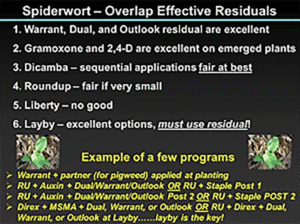
*Tropical spiderwort remains a major pest for many of us. To successfully manage this, one must understand the importance of strategically applying effective residual herbicides throughout the growing season, starting at planting. The most effective herbicide option at planting is Warrant. If the weed is up before planting, Gramoxone + diuron or 2,4-D are extremely effective. ∆
UNIVERSITY OF GEORGIA EXTENSION
LINK: https://site.extension.uga.edu/tiftcoag/2026/04/ryegrass-and-dusting-in-cotton/