

JAMES VILLEGAS AND DR. DAWSON KERNS – WINNSBORO, LOUISIANA
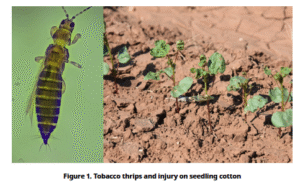
Thrips are the most consistent early-season insect pest of cotton in Louisiana. Tobacco thrips are usually the dominant species, with western flower thrips sometimes present at lower levels. Thrips feed on tender, expanding leaf tissue with piercing–sucking mouthparts, causing crinkled or cupped leaves, stunting, and delayed maturity, especially when cotton is growing slowly under cool, wet, or otherwise stressful conditions. Because thrips lay eggs inside the plant tissue and immatures often feed in protected terminal, foliar sprays can be hard to time perfectly. The goal of thrips management is not to eliminate every thrips but to protect cotton during the short vulnerable window from emergence through about the 3rd–4th true leaf stage (when growth is rapid), so the crop can maintain a strong, uniform start.
1) Scout early and treat based on immatures + plant stage
Begin scouting soon after emergence and continue at least weekly (twice weekly under high risk) until cotton is past the thrips-susceptible stage. Check the terminal and the newest leaves across multiple areas of the field. A few adult thrips may simply just be migrating into the field. Immature thrips are more important because they indicate successful reproduction and a higher risk of ongoing injury. A practical action guideline is to treat when the field averages about one or more immature thrips per plant, or when large numbers of adults are present with fresh injury to new leaves on small, slow- growing cotton. Under good growing conditions, treatment is usually not needed once cotton reaches the 4th true leaf stage.
2) At-plant protection
Preventive at-plant protection provides the most consistent return because thrips attack immediately and are difficult to reach with foliar sprays once injury is visible. Insecticide seed treatments (ISTs) are the most common approach, but performance can vary with weather and thrips pressure. Be aware that low-rate ‘base’ seed treatments often provide little field protection. Standard imidacloprid rates (commonly ~0.375 mg active ingredient per seed) are typically considered the minimum for reliable insect control.
In-furrow (IF) insecticides can replace or supplement ISTs and are often more effective but require additional equipment and calibration. Options include IF imidacloprid and granular aldicarb (AgLogic 15G). Aldicarb often provides excellent thrips control and may reduce the need for supplemental foliar sprays.
3) Use foliar sprays only when justified
When at-plant protection is overwhelmed (heavy pressure) or plant growth is slowed by stress, a supplemental foliar insecticide may be needed. Applications are most effective when made early (often by the 1st–2nd true leaf stage) before severe injury accumulates. Current Louisiana recommendations include spinetoram-containing products (e.g., Intrepid Edge) because they provide good thrips control and are less likely to flare aphids or spider mites than some organophosphates. Organophosphate performance (e.g., acephate, dicrotophos) can be inconsistent in areas where reduced susceptibility or resistance has developed, so check fields after applications. In addition, Vertento® (isocycloseram) is a new product that also provides effective control of thrips.
4) Consider ThryvOn® cotton as an at-plant option (where available)
ThryvOn is a cotton trait with activity against thrips. It primarily reduces feeding and egg-laying, so adults may still be present, but damaging injury and immatures are typically much lower. ThryvOn cotton generally does not require additional in-furrow or foliar treatments specifically for thrips. Any visible injury is usually cosmetic and not economically important. Additional at-plant insecticides may still be chosen for other pests (e.g., certain soil insects or nematodes), not for thrips.
5) Practice insecticide stewardship (resistance management)
Tobacco thrips have documented resistance to multiple insecticide classes in the southern U.S., including reduced sensitivity to some neonicotinoids and organophosphates in certain areas. To protect product performance, rotate insecticides by mode of action when multiple applications are needed, avoid repeated use of the same chemistry, and keep good spray records.
For the most current Louisiana-labeled products, rates, and precautions, consult the annual LSU AgCenter Field Crops Insect Pest Management Guide and always follow the product label. 2026 Louisiana Field Crops Insect Management Guide (https://www.lsuagcenter.com/articles/page1772656534871) ∆
JAMES VILLEGAS AND DR. DAWSON KERNS – LSU AGCENTER
LINK: https://www.lsuagcenter.com/articles/page1776440682396