

By Carroll Smith / Contributing Editor
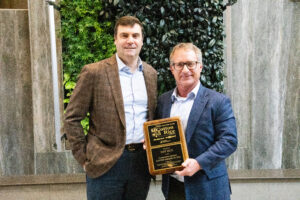
Jeff Hux, who was recognized as Cotton Farmer of the Year at the 29th Annual National Cotton & Rice Conference, farms in the unique agricultural area known as the Missouri Bootheel in the northern portion of the Mississippi Delta.
When he was in his early 30s, Hux’s father, John Hux Jr., began farming in a partnership arrangement. In the late ’60s, John bought out his partner, and Triangle Farms was born and is based out of New Madrid County.
“I helped my dad on the farm from the time I was 12 years old,” Hux said. “He even gave me a work truck when I was 13, and I drove all over the countryside. It was a different world back then. When I used to get so motivated working on the farm, my dad would call me the foreman of irrigation, which just meant I was the runt.”
Hux said he grew addicted to farming and knew that’s what he wanted to do. Throughout high school, he would work and help out wherever he could on the farm.
Destined For A Cotton Career
After graduating from high school, Hux went to Texas A&M University, which he said was the top ag school in the country and always involved with research. In 1995, he received a degree in Agricultural Systems Management — which is in the Ag Engineering Department — with a minor in agronomy.
“After graduating, I moved back to Southeast Missouri to work for my dad on the farm for three years,” Hux said. “In 1998, I bought 50 percent of Triangle Farms from him, and we became business partners. I jokingly say it was the most fun I’ve ever had farming because all I did was farm while my dad took care of the office and the book work.
“Shortly thereafter he chose to retire, and I had to take up the reins on everything. That was a game changer at that point in time.”
Today, Hux primarily grows cotton, supplemented by soybeans and field corn, along with a little bit of popcorn. The acreage is about 96 percent irrigated.
For the past 20 years, he has planted cover crops in the fall. He started out with wheat but has now switched to planting a blend of legumes and small grains. This approach provides benefits such as erosion reduction, early weed suppression, and soil improvement, which can contribute to improved yields at the end of the season.
Sustainable Cotton Preferred
The second-generation farmer supports the growth of sustainable production systems, makes an effort to reduce cotton’s environmental impact, and stays up to date on new developments in ag technology. As chairman of Cotton Incorporated, Hux is proactive is talking with brands and retailers to find out what they are looking for in cotton.
“One of the things they always want is sustainable cotton,” he said. “With that in mind, I try to stay involved with organizations that promote sustainability. I am a member of the U.S. Cotton Trust Protocol and the Better Cotton Initiative. I also am a regenagri producer and an Indigo Ag producer. Here is how they typically work.
“For example, Indigo Ag will come in and audit your company to make sure your farming practices are sustainable practices. They also look at the carbon footprint to determine that you have the least amount of soil erosion or wind erosion and that you are not overapplying fertilizers.”
Hux said what these organizations’ audits bring to the table is help create more demand for your cotton and help it sell faster.
Fewer Means More
Hux has also incorporated practices to increase efficiency on his farm. For example, he used to till the land a lot, but now Triangle Farms is a minimum-till operation. The land is only tilled one time, and that is in the fall after the crop is harvested.
“Today, we don’t make as many trips across the field as we once did,” he said. “We’re more efficient with every pass. We customize our implements to try to avoid more than one pass. Although there are occasional exceptions, typically, whenever you see a tractor running across my field, it’s doing more than one thing at a time.”
The Missouri cotton farmer also enlists the help of crop consultants — Tim Roberts and Billy Beegle of TennArk Crop Service based in Dyersburg, Tennessee. Hux says these men provide many services for Triangle Farms.
“Tim and Billy help me throughout the growing season with various herbicide mixtures,” Hux said. “They look every week for bugs. They won’t spray unless a field has reached threshold. This, in turn, decreases my insecticide applications. They keep me informed with a weekly report.
“Another big role they play involves defoliation. In Southeast Missouri, when it’s time for cotton to be
defoliated, it’s almost an art, quite honestly, because our temperatures by that time are cold. So every year your defoliation plan is different. We always have to have different mixes because it depends on the temperature and on the forecast.
‘If it’s supposed to get below freezing, then we have to be more aggressive and so forth. It’s challenging, but those two guys are very good.”
Cotton Marketing Decisions
One of the significant challenges cotton farmers face today involves the markets.
“We’ve had a highly volatile market with an erratic trade policy,” Hux said. “That, and the exchange rate of a dollar being strong, decreased demand for our commodities. And in turn, you’re trying
to market your crop, but you’re marketing it at a loss. You were definitely selling below your operating cost.
“Instead of asking how do I make a profit, you ask yourself how do I minimize my loss? This creates a different dynamic when you’re trying to market your crop. I market all my cotton through Staplcotn and serve on its Board of Directors.
“They do a wonderful job, and they’re able to look at the markets each and every day, analyze them, and sell my crop for me while I’m working. I don’t have to worry with it. I let them do that.
‘Good’ Trumps The Bad And The Ugly
Hux currently serves as Vice Chairman of Cotton Incorporated, and according to Dr. Ryan Kurtz of CI, he is “a strong leader who has advanced the cotton industry at both the state and national level.”
Being on the Board of Directors allows those members not only to be informed but to have a voice as well. If an issue arises, they can have a conversation about it at that point in time. Cotton Incorporated also is able to conduct research and promotion in a manner that benefits not only producers but also the importers who are assessed as well.
In drawing back the curtain on the big picture, Hux said these are probably some of the toughest financial times ever seen within the cotton industry.
“Cotton is under attack,” Hux said. “However, I don’t think I’ve ever seen the cotton industry come together like they are currently. Cotton Incorporated, The Cotton Board, and the National Cotton Council are all truly working as a team to try to fix the industry. That’s a positive, and I believe we’re going to come out of this depression in the cotton markets and get our market share back.”
Life’s Blessings
When asked what he enjoys most about growing cotton, Hux said it’s managing the crop and watching it grow and respond to the inputs.
“If cotton needs something, and you provide it, it’s always happy,” he said. “Cotton almost has to be in your blood to appreciate it, but it’s a very satisfying crop.”
Although farming involves a lot of hard work, Hux said he enjoys his job and tries to give it his best every day to fulfill his responsibilities to his family and his employees. Even in tough economic times like what we are dealing with right now, you always have to put one foot in front of the other and just go with it.”
Hux and his wife, Tara, have raised three children and are now watching them branch out in search of their own paths in life.
The elder son, Nicholas is about to complete his master’s degree in aerospace engineering at Florida State, and 22-year-old Connor will graduate in May from the University of Alabama with a degree in operation management.
“I think farming could be in Connor’s future, but he wants to explore all his options,” Hux said. “He’s definitely the most interested, but he hasn’t committed. He’s going to get a job in the outside world, and if farming is his true calling, then he’ll be back. And our daughter, Savannah, is a freshman at the University of Alabama who plans to go to nursing school.
“Since we are empty nesters now, my wife, Tara, has gotten more active in the farming business. As a matter of fact, last year she ran a cotton picker at night for me. She’s more engaged in the whole operation, which has been fun.”
Transforming The Bootheel
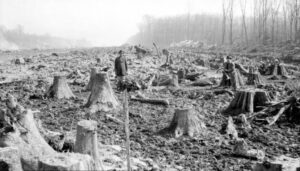
- Courtesy of the Missouri State Archives
Transforming The Bootheel
Southeast Missouri’s “Bootheel” is a natural basin for Mississippi River flooding. For much of its history, the land was an uninhabitable swamp.
Many thousands of acres of swampland in Southeast Missouri were cleared and drained in order to convert them to agriculture in the early 1900s.
It was the world’s largest drainage project, and by its completion had moved more earth than the construction of the Panama Canal. The Little River Drainage District was constructed between 1914 and 1928. It consists of 957.8 miles of ditches and 304.43 miles of levees. It covers 540,000 acres and drains a total of 1.2 million acres.