

Specialists Speaking – JOSH LEE ALABAMA
Achieving a good stand of cotton is one of the first steps of the cotton-growing process that is visible above ground. Evaluating a stand of cotton is almost like getting your grades back on a report card. The stand shows how well the seed germinated in those environmental conditions at the time of planting. We can also evaluate the effectiveness of seed treatments, pre-emergent herbicide applications, and planter settings at this time.
Under warm temperature conditions, cotton will emerge between five and 10 days. Once cotton emerges and begins to grow, the next step is to promote good early season growth. Seedling vigor in cotton refers to the ability of a cotton plant to produce above- and below-ground plant biomass. Seedling development is greatly influenced by temperature. More sunshine with sufficient water equals faster crop development. In cases where cotton is planted early, temperature conditions can be sufficient to get a good stand, but in a weeks’ time a cold front arrives, and temperatures turn cool for a few days. In those conditions, cotton seems to just “sit there,” waiting for warmer temperatures to jumpstart plant growth. With that, it is important to have good thrips protection.
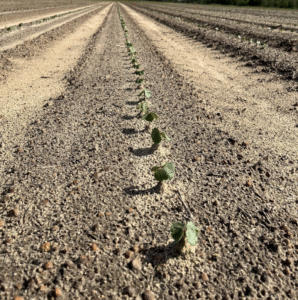
Image 1. Healthy cotton
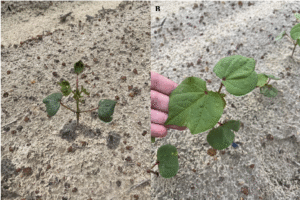
Image 2. Cotton with only seed treatment for thrips protection (A) and cotton with ThryvOn technology (B).
For thrips management, there are several tools available. At-plant thrips management tools include seed treatments, in-furrow insecticides, and utilizing ThryvOn technology. During the early season, foliar insecticide applications must be considered if there are no thrips management tools already in place. Remember that thrips thresholds for ThryvOn cotton are different than non-ThryvOn cotton. When utilizing foliar insecticide applications, the threshold for non-ThryvOn cotton is one adult thrips per plant with immatures present when damage is evident. ThryvOn should only be treated if there is excessive plant injury with adult thrips and immatures present. In many cases, thrips will be present on ThryvOn cotton but little plant injury will be observed. Currently, the Thrips Infestation Predictor for Cotton is predicting higher-than-normal pressure, peaking from April 25 through May 10.
One last thing to keep in mind to achieve a healthy stand is to be timely with post-emergent herbicide applications to prevent competition for sunlight and nutrients between unwanted weeds and seedling cotton. If you have questions about early season cotton and pest management, Alabama Cooperative Extension is here to help! Please don’t hesitate to contact your local Extension agent or specialist for more information. ∆
Specialists Speaking – JOSH LEE ALABAMA