Specialist Speaking- Josh Lee
Josh Lee
ALABAMA
As the crop enters August, there are numerous management decisions that have already been made by this point, but we are not yet at the finish line. At the time I’m writing this article, it is raining heavily from a pop-up thunderstorm. The typical summertime weather pattern (how I heard it growing up) is afternoon showers that could drop a few tenths of an inch to a few inches in only half an hour in some cases. This summertime weather pattern can interfere with timely cotton management, especially insecticide sprays. At this stage in cotton development, the crop is continuing to develop bolls and mature fiber. The most valuable assets that need to be protected on a cotton plant are bolls. Yield-robbing insects like plant bugs and stink bugs can wreak havoc mid-season if not treated in a timely manner.
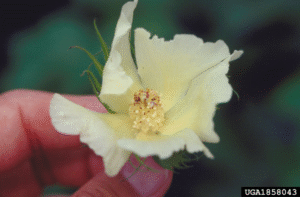
Plant bugs in blooming cotton are mostly nymphs that feed on large squares and young bolls in addition to small squares. Plant bug damage to young bolls results in “hard locking” of one or more locks per boll. Damage to large squares can be seen as “dirty blooms,” which show necrotic flower parts and warty petals caused by plant bug feeding. Controlling plant bugs in blooming cotton is generally warranted when 15% to 20% of quarter-diameter-sized bolls reveal internal plant bug damage.
Image 1: Adult tarnished plant bugs. Photo by Scott Graham
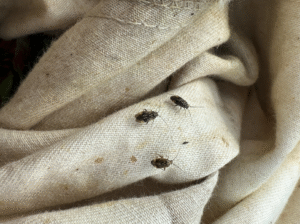
Image 2: “Dirty bloom” caused by tarnished plant bug feeding. Photo by Ron Smith, Auburn University, Bugwood.org
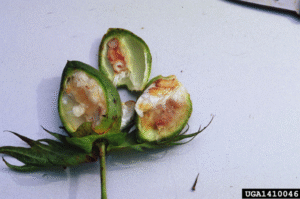
There are three main species of stinkbugs that occur in Alabama cotton. They are the green stink bug, the southern green stink bug, and the brown stink bug. Stink bugs damage cotton by feeding on developing seeds inside the bolls. There may be black dots on the outside of a boll, but that may or may not be true of stinkbug damage. The best way to evaluate damage is to crack bolls open and look for internal boll damage. Stink bug damage will turn the developing seeds brown, and a warty growth will be present on the capsule wall where the boll was penetrated by the insect. Controlling stinkbugs in cotton is generally warranted when 15% to 20% of quarter-sized bolls are damaged.
Image 3: Green stinkbug. Photo by Russ Owens, University of Georgia, Bugwood.org
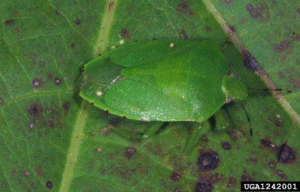
Image 4: Southern green stinkbug. Photo by Phillip Roberts, University of Georgia, Bugwood.org
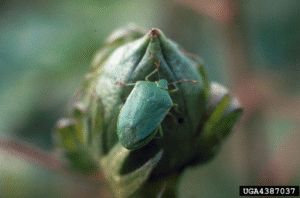
Image 5: Brown stinkbug. Photo by Russ Owens, University of Georgia, Bugwood.org
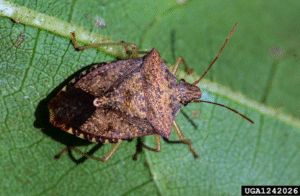
Image 6: Stinkbug damage in cotton. Photo by Ron Smith, Auburn University, Bugwood.org
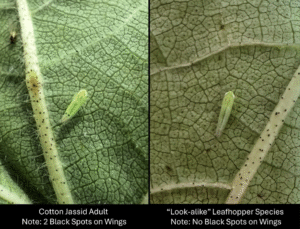
What about cotton jassids? At the time I’m writing this article, Alabama has not treated any commercial cotton fields for cotton jassids. Could this change? The answer is yes. In 2025 cotton jassid built populations across southeast Alabama and peaked in September. Cotton jassids are small, green, wedge-shaped leafhoppers. Adult cotton jassids can be distinguished from other leafhoppers by the presence of two black spots on the bottom of the wings. Cotton jassids will be on the undersides of the leaves. When scouting, look at the underside of at least 25 leaves from the fourth or fifth mainstem leaf from the plant terminal. This is the same area you look at for measuring fourth internode length for plant growth regulator decisions. The preliminary threshold, based on research and experience from 2025, is one cotton jassid per leaf (adult or nymph). For the most up-to-date information regarding thresholds and control recommendations, please contact your local Extension agent.
Image 7: Cotton jassid and leafhopper comparison. Photo by Scott Graham
If you have questions about mid-season cotton management, Alabama Cooperative Extension is here to help! Please don’t hesitate to contact your local Extension agent or specialist for more information.